Who Should You See for Dental Implants in Winter Garden?
Wondering who to see for dental implants in Winter Garden? Learn which providers place implants, what to ask, and how to choose with confidence.
Key Takeaways
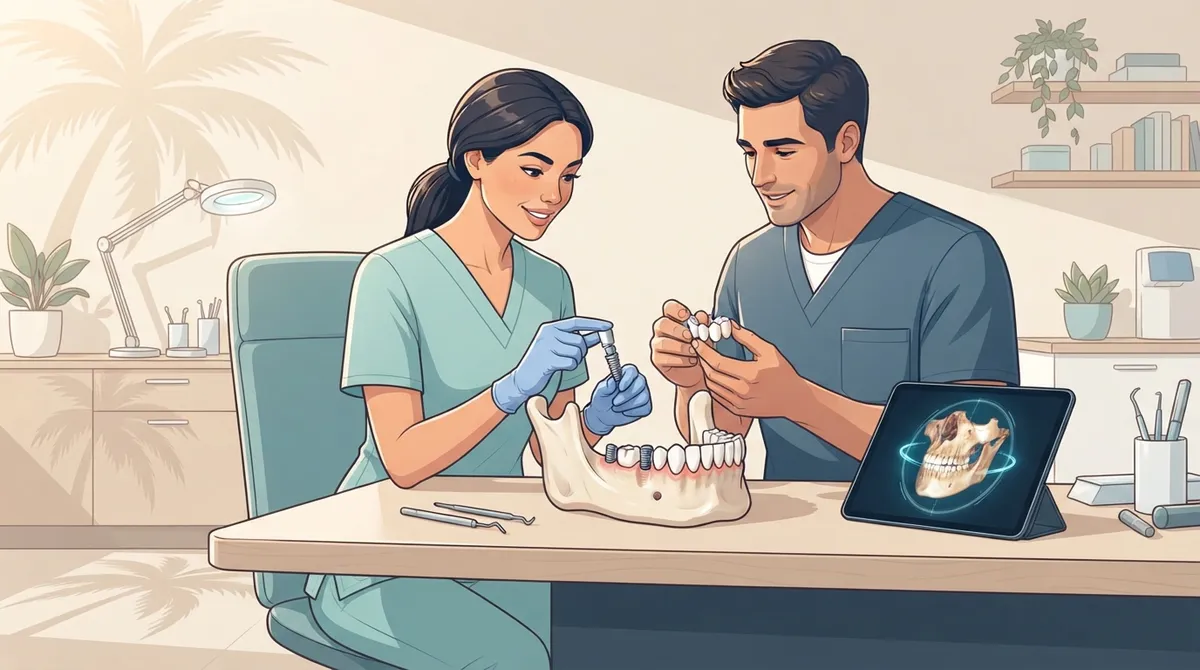
- Dental implant care may involve several clinicians: a surgeon or periodontist for placement and a restorative dentist for the crown, so ask who handles each step and how they coordinate.
- Simple single-tooth cases with healthy bone can often be handled by a trained general or cosmetic dentist, while complex surgery or bone loss usually calls for a periodontist or oral surgeon.
- Verify any Florida dentist's license through the state's official lookup, and ask where the provider completed specialty training and how many cases similar to yours they have treated.
- A good implant consultation should include a health history review, exam, 3D imaging of your bone, alternatives such as bridges or partial dentures, and a written estimate listing every stage.
- Ask about long-term maintenance before committing, since implants need ongoing cleanings, checkups, and monitoring for gum inflammation around the implant.
- Be cautious of high-pressure tactics, vague pricing, or providers who only discuss benefits and never explain risks or alternatives.
Missing a tooth can feel like a big deal. Maybe it makes you hide your smile in photos. Maybe chewing your favorite foods has become a chore. Either way, you have probably asked yourself, who should I see for dental implants in Winter Garden?
It is a great question, and the answer is a bit more layered than you might expect. Dental implants are not a one-person job in every case. Some patients work with a surgeon for the placement and a different dentist for the crown. Others get their whole treatment under one roof.
The good news? You do not have to figure this out alone. In this guide, we will walk through the types of providers who place and restore implants, what to ask at a first visit, how to check credentials, and how to compare your options with confidence. We will keep it simple, friendly, and honest.

Why Choosing the Right Provider Matters So Much
A dental implant is a small post that replaces the root of a missing tooth. A crown, bridge, or denture then attaches to it. When done well, an implant can feel and look a lot like a natural tooth.
But the result depends heavily on the person planning and placing it. Good planning protects your bone and gums. Careful placement helps the implant stay stable. A well-made crown helps you bite and chew comfortably.
Research backs up the long-term promise of implants. A 2019 systematic review of prospective studies estimated 10-year implant-level survival at about 96.4%. A 2024 meta-analysis of 20-year outcomes found survival estimates of roughly 88% to 92%. These numbers are encouraging, but they come from studies and not from a promise about your own mouth. Results vary with health, habits, and the quality of care.
The Main Types of Providers Who Handle Dental Implants
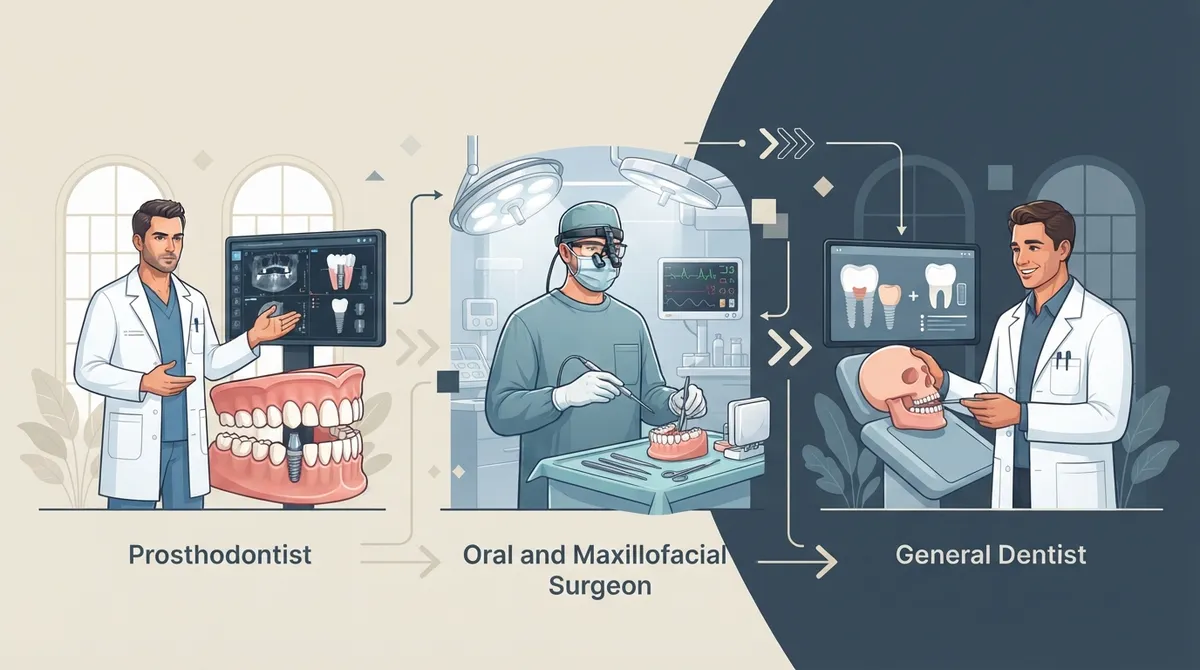
When people search for implant care in the Winter Garden area, they usually find a mix of specialists and general dentists. Here is a quick look at who does what.
| Provider Type | Typical Role in Implant Care | Best For |
|---|---|---|
| General or cosmetic dentist | May plan, place, and restore implants, or coordinate with specialists | Straightforward cases and patients who want one familiar team |
| Periodontist | Gum and bone specialist who often performs implant surgery | Gum disease, bone loss, or complex gum needs |
| Oral and maxillofacial surgeon | Surgical specialist who places implants and handles extractions and grafting | Complex surgery, multiple implants, or significant bone work |
| Prosthodontist | Specialist in designing crowns, bridges, and dentures | Full-arch cases and detailed smile design |
Notice that no single title is automatically "the best." The right fit depends on your case, your comfort level, and the clinician's real experience with situations like yours.
General and Cosmetic Dentists
Many general dentists complete additional training in implants. For simple cases, such as replacing one tooth where the bone is healthy, a trained general dentist can often manage the whole process. The big plus is continuity. You see the same friendly faces from your first exam to your final crown.
If your case turns out to be more complex, a good dentist will tell you honestly and refer you to a specialist. That kind of honesty is a great sign.
Periodontists and Oral Surgeons
These specialists focus on surgery. A periodontist knows gums and the bone that supports teeth. An oral and maxillofacial surgeon handles surgical procedures in the mouth and jaw. Either one may place your implant, and either may do bone grafting if you need it.
After the surgical part, they typically send you back to a restorative dentist for the crown. That is perfectly normal. It just means you will want to make sure the two offices communicate well.
Prosthodontists
A prosthodontist specializes in restoring and replacing teeth. They are often involved in the design of the final crown, bridge, or denture. If you need many teeth replaced, this skill set can be especially helpful.
Do You Need One Provider or a Team?
This is one of the most overlooked questions. Implant care can involve more than one clinician. Before you commit, ask these questions:
- Who will plan and place the implant?
- Who will make and attach the final crown, bridge, or denture?
- How will the providers share records and coordinate follow-up?
- Who do I call if something feels off after treatment?
Clear answers mean smoother care. Vague answers are your cue to keep asking.
Some patients love the simplicity of a single practice that handles the full journey. If that sounds like you, you might enjoy reading about dental implants in Ocoee to see what a start-to-finish approach can look like.
What a Good Implant Consultation Looks Like
Your first visit should feel informative, not pushy. A thorough consultation usually includes the following steps.
- Review of your health history. Your dentist should ask about medical conditions, medications, and habits like smoking.
- A careful exam. This covers your teeth, gums, bite, and any signs of infection or gum disease.
- Imaging. X-rays or 3D scans help show the amount and quality of your bone.
- A talk about options. You should hear about alternatives, not just implants.
- A clear plan and timeline. This includes any prep work such as extractions or grafting.
- A written estimate. It should spell out what is and is not included.
If you want a deeper look at what to expect, our guide on what happens at a dental implant consultation in 2026 walks through the visit step by step.
How to Check a Provider's Credentials in Florida
Trust is built on facts. Before you book, do a little homework. It only takes a few minutes and can give you real peace of mind.
- Confirm Florida licensure. You can verify a dentist's license through the state's official licensing lookup.
- Ask about specialty training. If someone calls themselves a periodontist, oral surgeon, or prosthodontist, ask where they trained.
- Ask about experience. How many cases like yours have they handled? Can they show before-and-after examples?
- Look at professional memberships and certifications. These are useful details to verify, though they are not a guarantee of any outcome.
- Read reviews with a thoughtful eye. Look for patterns about comfort, communication, and follow-up care.
For more ideas on screening a practice, check out these 3 mistakes to avoid when choosing a dental implant dentist.
Questions to Ask Before You Say Yes
A confident provider welcomes questions. Bring this list to your appointment:
- What type of implant and materials do you use?
- Will I need a bone graft or other prep work?
- What is the full timeline from start to finish?
- What are the risks, and what happens if a complication comes up?
- What does your fee include, and what could add to it?
- What are my alternatives, such as a bridge or partial denture?
- What does long-term care and monitoring look like?
That last question matters more than people realize. Implants need ongoing care. Your provider should explain cleaning routines, checkup schedules, and how they watch for gum inflammation around the implant.
Alternatives to Implants Worth Knowing About
An honest provider will discuss options beyond implants. Depending on your health and goals, you might also consider a conventional bridge or a removable partial denture. Each has trade-offs in cost, comfort, and how it affects neighboring teeth.
If you are weighing choices, this comparison of dental implants vs. dentures can help you think it through. You may also like our breakdown of dental implants vs. bridges.
Thinking About Cost and Payment
Cost is a real part of the decision, and it deserves a straight answer. The price of an implant depends on how many teeth you are replacing, whether you need grafting, and what type of restoration goes on top. Always ask for a written estimate that lists each stage.
Many patients also look into financing and insurance help. It is smart to learn the common pitfalls before you start, so take a peek at these 7 dental implant cost mistakes. And if budgeting is on your mind, our guide to 9 ways to finance dental implants in Winter Garden, FL offers practical ideas.
Special Considerations for Different Patients
Every smile story is different. Here is how some common situations can shape your search.
If You Feel Nervous About the Dentist
Dental anxiety is incredibly common, and you are far from alone. Look for a practice that talks openly about comfort, offers a calm setting, and never rushes you. A gentle, spa-like atmosphere can make a huge difference for how you feel in the chair.
If You Are a Senior Patient
Age alone is not usually the barrier people fear. What matters more is your overall health and bone condition. If you have been wondering about this, you may find it helpful to read whether dental implants are still safe after age 65.
If You Are Replacing Several Teeth
Multiple missing teeth may call for a team approach or a full-arch solution. It helps to understand your choices early. Our article on how to choose full mouth dental implants covers what to look for.
Red Flags and Green Flags to Watch For
Sometimes your gut tells you a lot. Here is a simple cheat sheet.
| Green Flags | Red Flags |
|---|---|
| Clear explanation of the full plan and timeline | Pressure to decide on the spot |
| Discussion of alternatives and risks | Only talks about the positives |
| Written estimate with details | Vague pricing or surprise fees later |
| Verifiable license and training | Unwilling to share credentials or experience |
| Plan for follow-up and maintenance | No talk of aftercare |
Your Local Options and How to Compare Them
If you search around Winter Garden, you will see several practices that mention implant services, including periodontal offices, oral surgery offices, and multi-specialty practices. These are good places to start your research. Just be sure to confirm current services, clinicians, credentials, and availability directly, because details can change.
Nearby communities offer options too. If you are open to a short drive, finding the best dental implants in Ocoee, FL is worth a look, and our guide to choosing an implant dentist in Ocoee offers more tips.
At Charming Smiles of Ocoee, Dr. Aliuska Lopez and our team take a gentle, personalized approach to implant care in a relaxing, spa-like setting. We offer a free dental implant consultation so you can ask questions, see your options, and get a clear plan with no pressure. You can learn more about our dental implants and see what other patients say when you visit us on Google — Charming Smiles of Ocoee.
What to Expect After Your Implant
Getting the implant is only part of the story. Healing takes time, and good habits protect your investment. Expect to follow cleaning instructions closely, keep up with regular checkups, and report any swelling, bleeding, or discomfort early.
Want to know what the whole journey looks like on a calendar? Our guide to planning your dental implant timeline breaks it into stages. For aftercare habits, see these 5 implant care instructions.
You can also explore how our team works on the whole experience by reading about how to know if dental implants are right for you.
The Bottom Line: Who Should You See?
So, who should you see for dental implants in Winter Garden? The honest answer is the provider who fits your case, explains things clearly, and plans for long-term care.
- For simple cases, a trained general or cosmetic dentist may handle everything.
- For complex surgery or bone needs, a periodontist or oral surgeon may be the right call.
- For detailed restorations, a prosthodontist or skilled restorative dentist can help.
- In all cases, verify licensure, ask about experience, and get a written plan.
Take your time, ask lots of questions, and choose a team that makes you feel heard. You deserve a smile you feel great about.
Ready to talk it through? We would love to meet you. Call us at (407) 378-3704 to schedule your free implant consultation, or find our location at 315 West Rd in Ocoee. You can also book online in just a few clicks.
FAQs
Q: Who places dental implants in Winter Garden, FL?
A: Implants may be placed by periodontists, oral and maxillofacial surgeons, and some trained general or cosmetic dentists. A prosthodontist or restorative dentist often makes the final crown. Always confirm each clinician's training and experience for your specific case.
Q: Should I see a periodontist, oral surgeon, prosthodontist, or general dentist for an implant?
A: It depends on your needs! Simple single-tooth cases may be handled by a trained general dentist, while complex surgery or bone loss may call for a specialist. The best choice is a provider who explains the plan clearly and has real experience with cases like yours.
Q: How do I check a dental implant provider's credentials in Florida?
A: Start by verifying their Florida license through the state's official lookup. Then ask about their specialty training, experience with similar cases, and professional memberships. These details are helpful, though they are not a guarantee of results.
Q: What should I expect at a dental implant consultation?
A: You should get a full exam, a review of your health history, imaging, and a talk about your bone and gum health. Your dentist should also explain alternatives, risks, timeline, and give you a written estimate. A good consultation feels helpful, never pushy.
Q: Will I need a bone graft before getting a dental implant?
A: Some patients do, and some do not. It depends on the amount and quality of your jawbone, which your dentist will check with imaging. If a graft is recommended, it should be explained clearly and included in your written plan.