Is Invisalign Right for Mild to Moderate Misalignment?
Discover how Invisalign treats mild to moderate misalignment, from crowding to spacing, with insights from Charming Smiles of Ocoee.
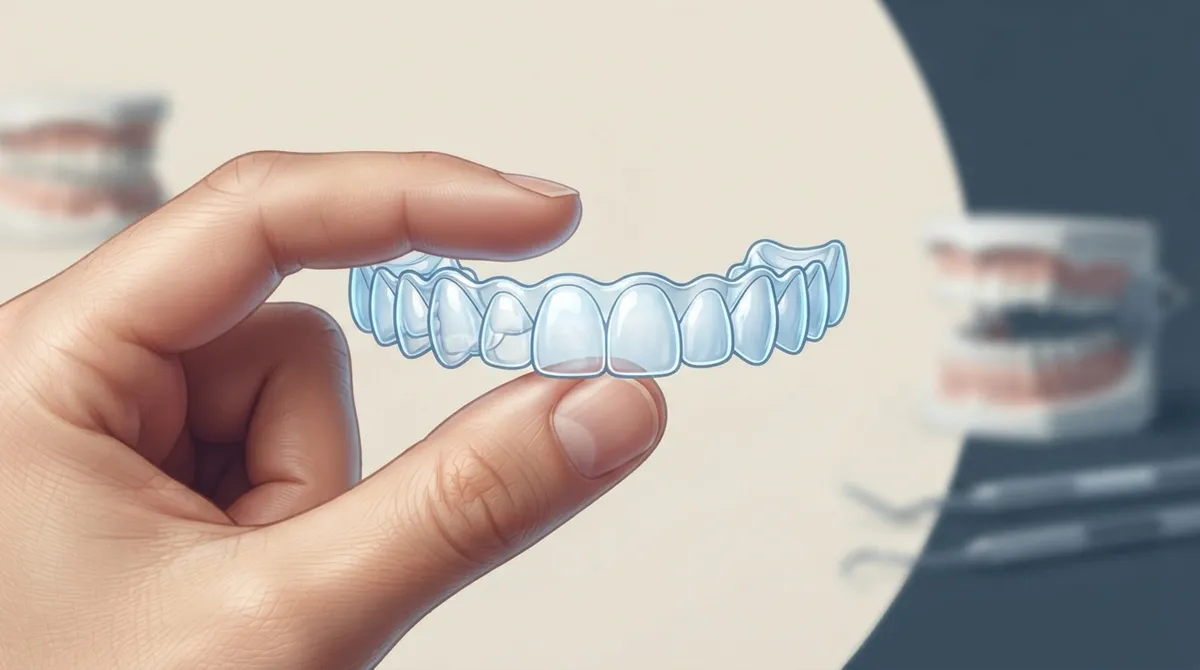
Key Takeaways
- Invisalign is most effective for mild to moderate misalignment cases including small gaps, minor crowding, and slight rotations, with research confirming clear aligners are the clearest indication for these specific conditions.
- You must wear Invisalign aligners 20-22 hours daily for treatment to work effectively; inconsistent wear time is the number one reason treatment gets delayed and trays may stop fitting correctly.
- Treatment timeline varies from a few months for mild crowding to over a year for moderate cases depending on the complexity of tooth movement needed and individual healing speed.
- Severe cases with impacted teeth, major jaw discrepancies, or extensive bite corrections require alternatives to Invisalign alone, making a professional dental examination essential to determine suitability.
- Retainers are mandatory after treatment completion because teeth naturally shift back over time; skipping retention is the most common reason people see their teeth return to their original positions.
- Invisalign requires pre-treatment dental health checks to treat cavities and manage gum disease first, as wearing aligners over untreated decay or inflamed gums can worsen existing problems.
Do you have a small gap between your front teeth? Maybe a little crowding on the bottom row? You might think you need metal braces to fix it. Good news: you probably don't. Invisalign for mild to moderate misalignment has become one of the most popular ways to straighten teeth without anyone even noticing you're doing it.
At Charming Smiles of Ocoee, we see patients every week who are surprised to learn just how much clear aligners can do. Dr. Aliuska Lopez and her team have helped countless Ocoee residents get straighter smiles using this gentle, nearly invisible method. Let's talk about what mild to moderate misalignment actually means, whether Invisalign can fix yours, and what you should expect along the way.
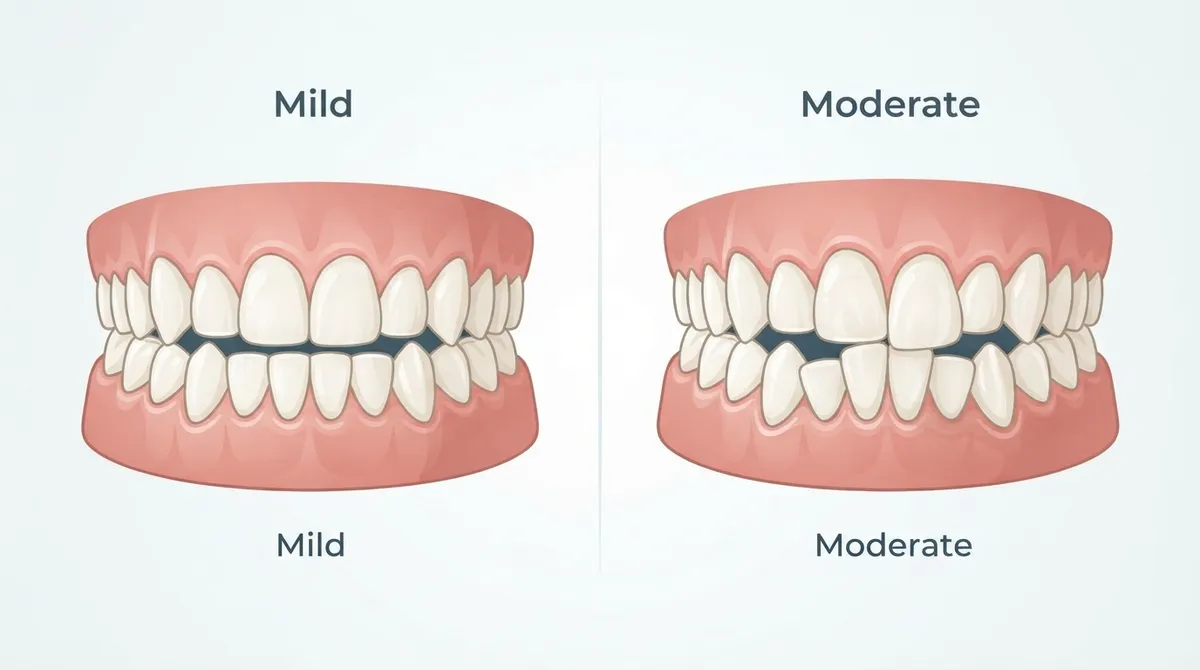
What Counts as Mild to Moderate Misalignment?
Not all crooked teeth are the same. Dentists usually sort misalignment into categories based on how severe it is. Understanding where you fall helps you know if Invisalign could be your best option.
- Slightly crowded front teeth that overlap a bit
- Small gaps or spaces between teeth
- Minor shifting after you stopped wearing an old retainer
- Small bite issues that don't affect your jaw structure
- Teeth that are just a little rotated, not severely twisted
If any of these sound like you, there's a good chance you're a candidate for clear aligner treatment. But every mouth is different, so a personal exam is always the best next step. A 2025 systematic review published in the Journal of Evidence-Based Dental Practice found that mild to moderate malocclusions are the clearest current indication for clear aligner therapy, while severe issues like impacted teeth or major jaw discrepancies usually need other approaches.
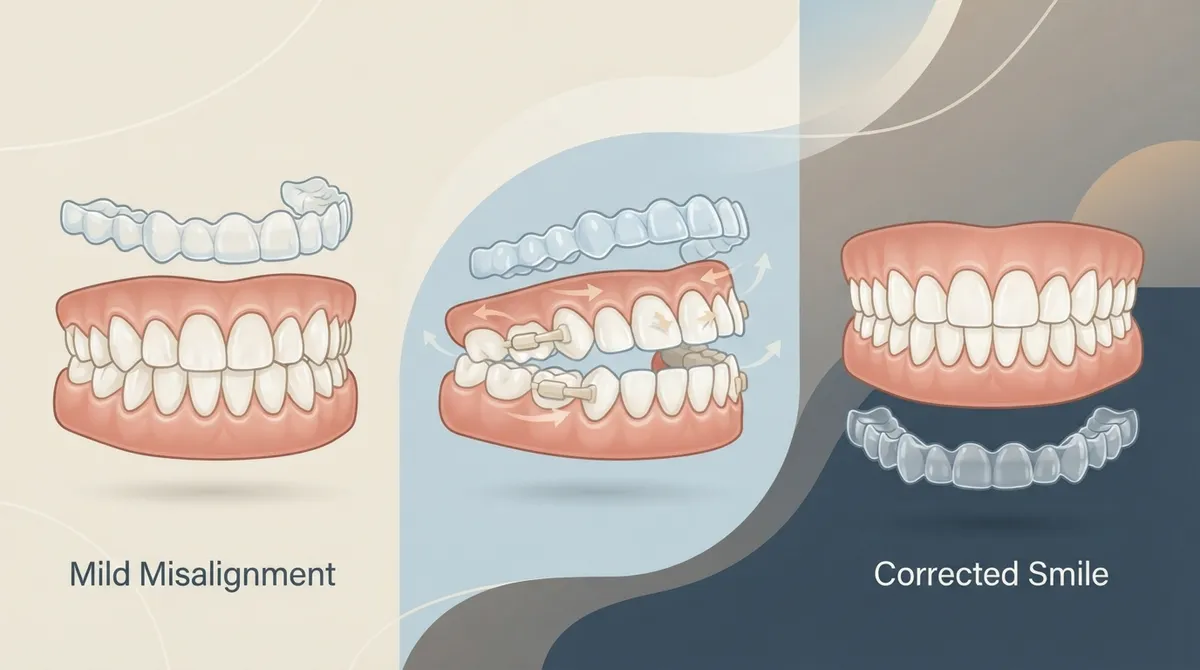
How Invisalign Actually Works for Your Smile
Invisalign isn't magic, but it sure feels close. It uses a series of clear, custom-made trays that slowly shift your teeth into place. Your dentist plans out every movement using digital scans before you ever put on your first tray.
The Basic Steps of Treatment
- You get a consultation and digital scan of your teeth
- Your dentist creates a custom treatment plan using computer software
- You receive your first set of aligners to start wearing
- You switch to a new set of trays every one to two weeks
- You visit your dentist regularly to check your progress
- You may need small dental attachments or elastics for tricky movements
- Once treatment ends, you wear a retainer to keep your new smile
This step-by-step process is why Invisalign works so well for simpler cases. Each tray moves your teeth just a tiny bit, so nothing feels rushed or forced.
Why Mild to Moderate Cases Work So Well With Clear Aligners
Here's the truth: not every dental problem is a great match for aligners. But mild to moderate crowding and spacing? That's kind of Invisalign's specialty. A 2023 scoping review found that clear aligners can effectively handle mild to moderate crowding, and simple tipping movements tend to be very predictable.
Think of it like moving furniture. Sliding a chair a few inches is easy. Moving a couch through a narrow hallway takes more planning and effort. Mild misalignment is like that chair. Moderate misalignment might need a bit more coordination, but it's still very doable with the right plan.
Movements That Respond Well to Invisalign
- Simple tipping of teeth in one direction
- Closing small gaps between teeth
- Reducing mild crowding in the front teeth
- Correcting minor rotations
- Fixing small relapse after old orthodontic work
Movements That Can Be Trickier
- Significant tooth rotations
- Extrusion or intrusion (moving teeth up or down)
- Major bite corrections like large overbites
- Severe crowding that needs extra space
- Complex root movements
A 2025 systematic review of clear aligner indications noted that aligners are generally less effective than fixed appliances for some of these complex movements. That doesn't mean Invisalign won't work. It just means your dentist might add attachments, elastics, or refinement trays to help.
Invisalign vs. Braces for Mild to Moderate Cases
Many patients ask if Invisalign is really better than metal braces for simpler cases. The honest answer is that both can work, but they offer different experiences.
| Feature | Invisalign | Traditional Braces |
|---|---|---|
| Visibility | Nearly invisible | Metal brackets are visible |
| Removability | Removable for eating and brushing | Fixed in place |
| Diet Restrictions | None, since you take them out to eat | Some foods must be avoided |
| Oral Hygiene | Easy to brush and floss normally | Requires special tools around wires |
| Best For | Mild to moderate crowding and spacing | Wide range including complex cases |
| Office Visits | Fewer chair-time visits typically | More frequent adjustments |
A 2025 meta-analysis reviewing 21 randomized controlled trials with 970 participants found no significant difference in several overall outcomes between clear aligners and fixed appliances for simple, non-extraction cases. However, researchers noted the overall evidence quality was still considered low, so results can vary person to person.
How Long Does Treatment Typically Take?
This is probably the question we hear most often at our Ocoee office. The honest answer is that it depends on your specific case. Mild crowding might take as little as a few months. Moderate cases with more complex movement can take a year or longer.
Several things affect your timeline:
- How much movement your teeth actually need
- Whether your case involves rotation or bite correction
- How consistently you wear your aligners each day
- Whether you need refinement trays toward the end
- Your individual healing and tooth movement speed
Published research and clinical reviews commonly report that clear aligners can offer an efficiency advantage in mild-to-moderate cases, though evidence remains mixed. Your dentist can give you a much more accurate estimate once they've examined your smile in person.
The Wear Time Rule You Really Need to Follow
Here's something that surprises a lot of patients. Invisalign only works if you actually wear it. Sounds obvious, right? But it's the number one reason treatment gets delayed.
You need to wear your aligners about 20 to 22 hours every day. That means only taking them out to eat, drink anything besides water, and brush your teeth. If you keep missing your wear time, your trays might stop fitting correctly, and your treatment could take much longer than planned.
Tips to Stay on Track With Wear Time
- Set a phone reminder to put your aligners back in after meals
- Keep a travel case with you at all times
- Brush your teeth right after eating so you can pop trays back in fast
- Avoid snacking throughout the day since you'll need to remove trays each time
- Track your progress with a simple calendar or app
Can Invisalign Fix Bite Problems Too?
Some patients with mild to moderate misalignment also have small bite issues like a slight overbite, underbite, or crossbite. Clear aligners can sometimes help with these, but the results depend heavily on how severe the bite problem is.
A 2023 scoping review found that overbite correction remains less predictable than simple crowding fixes. Buccolingual tipping (a side-to-side tooth movement) was among the most predictable movements studied, while rotation, intrusion, and extrusion were among the least predictable. This is why your dentist needs to look closely at your bite before recommending Invisalign as your treatment path.
What Happens Before Treatment Begins
Before starting Invisalign, your dentist needs to make sure your mouth is healthy enough for treatment. This step is often overlooked but incredibly important.
- Any active cavities need to be treated first
- Gum disease should be managed before aligners are placed
- Your dentist will check for restorations like crowns or fillings
- Bone and gum health will be evaluated
- X-rays or digital scans will map your current tooth positions
Wearing aligners over untreated decay or inflamed gums can make things worse, not better. That's why a full general dentistry checkup always comes first at our practice.
Life With Invisalign: What to Actually Expect
Once you start treatment, daily life doesn't change all that much. You'll get used to popping your trays in and out pretty quickly. Here's what most patients notice:
- Mild pressure or soreness for the first day or two with each new tray
- A slight lisp for the first week that usually goes away
- The need to carry a toothbrush for cleaning after meals
- Occasional attachments (small tooth-colored bumps) that help trays grip better
- Possible need for small amounts of interproximal reduction (filing between teeth) to create space
None of these should feel alarming. They're a normal part of the process, and your care team will walk you through everything before you start.
Do You Still Need a Retainer Afterward?
Yes, absolutely. This surprises some people, but teeth naturally want to shift back over time. Wearing a retainer after finishing Invisalign is what keeps your smile looking great for years to come.
Retention usually involves either a removable retainer, a bonded retainer behind your teeth, or a combination of both. Your dentist will build a schedule that fits your specific case. Skipping this step is one of the most common reasons people see their teeth slowly shift back to where they started.
Who Might Need Something Other Than Invisalign?
While Invisalign works beautifully for mild to moderate misalignment, it's not the right fit for everyone. According to that 2025 systematic review, severe malocclusions with impacted teeth or major jaw and facial skeletal deviations are generally considered unsuitable for clear aligner therapy alone.
Patients who may need orthodontic alternatives or a combined treatment approach include those with:
- Severely crowded teeth needing significant space creation
- Impacted teeth that haven't come in properly
- Major jaw discrepancies that affect facial structure
- Certain extraction cases requiring precise root movement
- Extensive bite corrections beyond mild adjustments
The good news is that your dentist can figure this out during your consultation. If Invisalign isn't the best fit, there are other paths to get you the smile you want.
Why Choose Charming Smiles of Ocoee for Your Invisalign Journey
Dr. Aliuska Lopez has built a reputation as a true smile expert here in Ocoee. Our office combines advanced digital scanning technology with a calm, spa-like setting designed to put you at ease. Whether you're a teenager nervous about a new smile or an adult who's always wanted straighter teeth, our team creates a plan built just for you.
We offer a free Invisalign consultation so you can find out exactly where you stand, with no pressure and no guesswork. Plus, current patients can save $200 on their treatment plan when they get started. Many of our happy patients love sharing their experience, and you can visit us on Google — Charming Smiles of Ocoee to read their stories for yourself.
We also stay active on social media where we share smile transformations and helpful tips. Feel free to check out our Charming Smiles Facebook page or follow along on our Charming Smiles Instagram page for updates and patient smiles.
Making the Decision That's Right for You
Choosing Invisalign for mild to moderate misalignment is a big decision, but it doesn't have to feel overwhelming. The best next step is simply talking to a dentist who can look at your teeth and give you real answers.
If you've been thinking about straightening your smile, now is a great time to explore your options. You can easily book online to get your free consultation scheduled. Our friendly team is ready to answer every question you have, from cost to timeline to what your results might look like.
Ready to see if clear aligners are right for you? Reach out to learn more about our location and how we can help, or simply call us at (407) 378-3704 to get started today. Your straighter, more confident smile could be closer than you think.
FAQs
Q: Is Invisalign effective for mild crowding and spacing?
A: Yes, it works really well for these cases! Mild crowding and small gaps are exactly what clear aligners handle best. Many of our Ocoee patients see wonderful results in a shorter time than they expected.
Q: How long does Invisalign take for mild to moderate misalignment?
A: It really depends on your specific smile, but mild cases can wrap up in just a few months, while moderate cases might take closer to a year. We'll give you a personalized timeline during your consultation.
Q: Can Invisalign fix an overbite, underbite, or crossbite?
A: Sometimes, yes, especially if the bite issue is mild. More complex bite problems may need extra tools like elastics or a different treatment approach, which your dentist can explain clearly.
Q: What happens if I don't wear my Invisalign aligners as directed?
A: Your treatment can slow down or your trays might stop fitting right. That's why we always encourage patients to aim for 20 to 22 hours of wear each day for the best results.
Q: Do teeth stay straight after Invisalign, or will I need retainers?
A: You'll definitely want a retainer! Teeth naturally try to shift back over time, so wearing your retainer as directed helps protect your beautiful new smile for years to come.