How to Decide If Dental Implants Are Worth the Money
Wondering if dental implants are worth the money? Follow our friendly step-by-step guide to weigh costs, risks, and alternatives with confidence.
Key Takeaways
- Implants cost about $4,000 nationally (median, including implant, abutment, and crown), but local prices vary, so always request an itemized written quote before comparing offices.
- Research shows about 96% of implants survive 10 years, though survival means the implant stays in place, not that no maintenance will ever be needed.
- Ask whether quotes include extras like extraction, bone grafting, imaging, anesthesia, and follow-up visits, since these can raise the total significantly.
- Implants avoid reshaping healthy neighboring teeth, unlike bridges, but they require surgery and healing time and cost more upfront than bridges or dentures.
- Smoking, gum disease, poorly controlled diabetes, and thin jawbone can affect implant results, but many of these can be treated before placement.
- Check your dental insurance benefits and ask about financing or payment plans, since coverage varies and can make the upfront cost more manageable.
Let's be honest: the price tag on a dental implant can make anyone's eyes widen. If you're sitting there wondering, are dental implants worth the money, you're asking exactly the right question. Replacing a missing tooth is a big decision, and you deserve straight answers, not a sales pitch.
Here's the good news. You don't have to guess. The answer depends on a few simple things: your mouth, your goals, your budget, and the other options on the table. In this friendly guide, we'll walk through a clear, step-by-step way to figure out whether an implant is a smart investment for you. We'll look at real numbers, long-term results, hidden costs, and alternatives like bridges and dentures.
Whether you're a busy parent in Ocoee, a senior who wants to eat steak again, or someone who just wants to smile without thinking twice, this guide is for you. Grab a cup of coffee, and let's make this decision feel a whole lot easier.
What Are You Really Paying For With a Dental Implant?
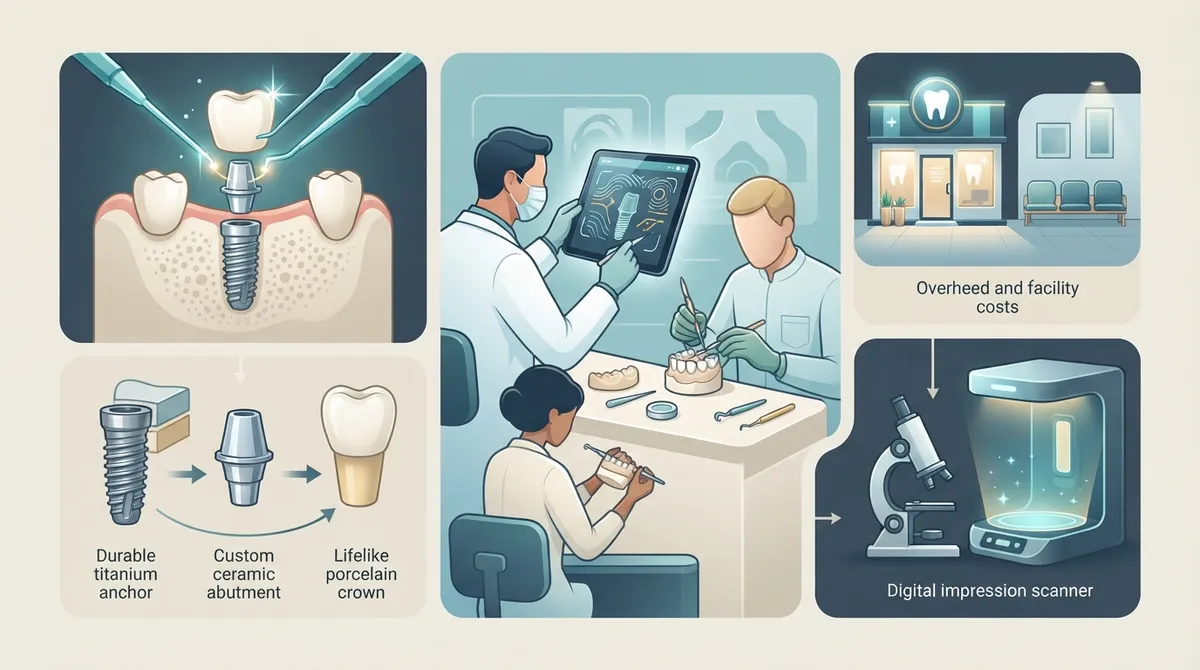
Before you can judge the value, you need to know what an implant actually is. A dental implant replaces the root of a missing tooth. A small post goes into the jawbone. Then a connector piece, called an abutment, attaches to the post. Finally, a custom crown sits on top and looks like a natural tooth.
That's what makes implants different. A bridge or denture replaces the part you can see. An implant rebuilds the part under the gum, too. Because it works like a real root, it can help you chew, speak, and smile with confidence.
Is it a perfect fit for everyone? No. It still takes surgery and ongoing care. But for many people, the stability and natural feel make the investment feel worthwhile. If you'd like to see how this treatment works in our office, take a look at our dental implants page.
Step 1: Look at the Numbers (Cost and Lifespan)
Let's start with the money part, because it matters. A 2026 Dental Economics article reported a U.S. nationwide median of about $4,000 for a complete dental implant in 2025. That figure covers the implant, abutment, and crown. Keep in mind this is a national median, not a promise for any one office. Local fees vary, so always ask for a written quote.
Now the encouraging part. A systematic review of studies published from 2010 to 2020 estimated about 96% implant survival at 10 years. Another review reported 97.2% survival at 5 years for implants that support single crowns. That's impressive staying power.
One honest note: "survival" means the implant stays in place. It doesn't mean nothing will ever need attention. A crown can chip, or a small screw can loosen. Think of it like a car. A great engine still needs regular service.
For a deeper look at pricing near you, check out how much dental implants cost in Ocoee, FL.
Step 2: Understand What the Price Includes
Here's where many people get surprised. Two quotes can look very different because they don't include the same things. Before you compare prices, ask exactly what's covered.
A complete single-tooth quote should clarify whether it includes:
- The implant post (fixture)
- The abutment connector
- The final crown
- X-rays and 3D imaging
- Tooth extraction, if needed
- Bone grafting, if your jawbone is thin
- Anesthesia or sedation
- Follow-up visits
Extra procedures can raise the total. A bone graft, for example, may be needed before the implant can be placed. That doesn't mean something is wrong. It just means your plan has more steps.
Getting the full picture upfront helps you avoid sticker shock later. It also makes comparing offices fair. If you want to dodge common budget traps, our guide on 5 dental implant mistakes that could cost you thousands is a handy read.
Step 3: Compare Your Options Side by Side
Value isn't just about price. It's about what you get for what you pay over time. Let's compare the most common ways to replace a missing tooth.
| Option | How It Works | Pros | Things to Consider |
|---|---|---|---|
| Dental implant | Post in the jaw plus a crown | Stand-alone, no need to alter nearby teeth, natural look and feel | Higher upfront cost, requires surgery and healing time |
| Conventional bridge | Crown on each side of the gap, with a false tooth between | Faster process, no surgery | Neighboring teeth must be prepared and reshaped |
| Removable partial denture | Replacement teeth held by clasps | Lower upfront cost, non-surgical | Can feel bulky, needs daily removal and cleaning |
| Leave the space | No treatment | No cost today | Nearby teeth may shift, chewing can be affected |
See how each choice has trade-offs? A bridge may cost less today. But it requires shaping healthy neighboring teeth. An implant avoids that step. A removable denture is budget-friendly, but some people find it less comfortable for everyday life.
Curious about the bridge route? Learn more in our post on dental implants vs. bridges in Ocoee. And if dentures are on your radar, see our overview of dentures.
Step 4: Check Your Health and Your Habits
Not everyone is an ideal candidate right away, and that's okay. Your dentist will look at several things before recommending an implant. Some health factors can affect results, including:
- Smoking or tobacco use
- A history of gum disease
- Diabetes that isn't well controlled
- Not enough jawbone to hold the implant
- Inconsistent brushing, flossing, or checkups
Please don't read that list as a "no." Many of these can be managed. Gum disease can be treated first. Thin bone can often be built up with a graft. The point is to be honest with your dentist so your plan fits you.
Your daily habits matter, too. Implants can't get cavities, but the gums around them can still get inflamed. In some cases, that can lead to bone loss and a problem called peri-implantitis. Good home care and regular visits are the best protection. To keep your routine on track, try these dental hygiene tips.
Step 5: Weigh the Risks and Be Realistic
A good decision means looking at the whole picture, including the bumps. Implants are reliable, but they aren't magic. Research shows some patients do run into complications.
One review of implant-supported single crowns estimated a 5-year cumulative rate of 7.1% for soft-tissue complications and 5.2% for implants with bone loss greater than 2 mm. Another review of implant-supported fixed bridges found that about 66.4% of patients were free of any complication after five years. In other words, high survival doesn't always mean zero issues.
Here's why that matters for your wallet. A chipped crown or loose screw may mean extra visits or repairs down the road. Planning for that possibility, and keeping up with checkups, helps you protect your investment.
The takeaway? Implants have strong long-term results, but they work best with great care and a skilled team. Ask your dentist what a realistic maintenance plan looks like for your case.
Step 6: Think About Your Quality of Life
Not every benefit shows up on a receipt. Ask yourself a few honest questions:
- Do I avoid certain foods because of a gap or loose denture?
- Do I hide my smile in photos or at family events?
- Would I prefer a fixed tooth over something I take in and out?
- Do I want to protect my neighboring teeth from being reshaped?
- Am I planning to keep this tooth for many years to come?
If you answered yes to several, an implant may offer real everyday value. Many of our affluent seniors in Ocoee tell us that the freedom to bite into an apple or enjoy a crunchy salad again is priceless. Younger adults often care most about a seamless, natural smile. And families like knowing they chose something built to last.
On the flip side, if you're on a tight budget right now or aren't ready for surgery, a different option may be the smarter move today. There's no shame in that. The best choice is the one that fits your life and your health.
Step 7: Plan How to Pay for It
Even when an implant makes sense, the upfront cost can feel heavy. The good news is you have options for making it more manageable.
Here are a few ways patients often spread out or reduce costs:
- Check what your dental insurance may cover, since benefits vary by plan
- Use flexible financing to turn one big payment into smaller monthly ones
- Look into an in-house savings plan for ongoing care
- Ask about current offers on consultations and treatment
At Charming Smiles of Ocoee, we accept many major plans, and we offer flexible financing so you can focus on your health, not just the bill. You can explore insurance and financing options, our dental savings plan, and our payment plans. It's also worth peeking at our current specials, which include a free dental implant consultation.
Want a bigger look at money-saving ideas? Our guide to navigating dental care financing in Ocoee walks through your choices in plain language.
Step 8: Get a Personalized Plan From a Dentist You Trust
Articles can only take you so far. The final step is a real conversation with a dentist who looks at your mouth, your X-rays, and your goals. A good consultation should feel like a partnership. You should leave understanding your options, your timeline, and your full cost.
Here's what to look for in an implant consultation:
- A clear explanation of why you do or don't need an implant
- A written, itemized quote with no surprises
- An honest talk about alternatives, not just one option
- Time for your questions, without any pressure
- A calm, comfortable setting
That last one matters more than people think. If dental visits make you nervous, you're far from alone. At Charming Smiles of Ocoee, we've built a spa-like environment with a gentle approach, led by Dr. Aliuska Lopez, a trusted "smile expert" known for compassionate, precise care. You can learn more about our team on our about us page, and hear from patients by reading what Ocoee patients say about their dentists.
So, Are Dental Implants Worth the Money?
For many people, yes. When you have a missing tooth, want a fixed solution, and are healthy enough for treatment, implants can be a smart long-term investment. The strong 10-year survival rates, the natural look and feel, and the fact that they don't require shaping neighboring teeth all add real value.
But "worth it" is personal. Implants cost more upfront. They need surgery, healing time, and lifelong care. Some patients face complications, and certain health factors can affect outcomes. A bridge or denture may be the better fit for your budget or your situation, and that's perfectly fine.
The best way to know is to compare a complete treatment plan and your alternatives with a qualified dentist. If you'd like to see our space and meet the team, you can visit us on Google — Charming Smiles of Ocoee to find directions and read reviews. We're also happy to chat on social, so feel free to say hi on our Charming Smiles Facebook page.
Ready to Find Out If an Implant Is Right for You?
You don't have to figure this out alone. Our friendly team is here to answer your questions, review your options, and build a plan that respects your budget and your comfort. Stop by our location on West Rd in Ocoee, or call us at (407) 378-3704 to book your free implant consultation. You can also book online in just a few clicks. Your best smile is closer than you think, and we'd love to help you get there.
FAQs
Q: Are dental implants worth the cost compared with a bridge or denture?
A: For many people, yes, especially if you want a fixed tooth and don't want your neighboring teeth reshaped. A bridge or denture often costs less upfront, so the best choice depends on your budget, health, and goals. A quick consultation can help you compare all three.
Q: How much does a single dental implant cost, and what's included?
A: A 2026 Dental Economics article reported a U.S. median of about $4,000 for a complete implant, covering the implant, abutment, and crown. Your local price may differ, and extras like bone grafting or extractions can add to the total. Always ask for an itemized written quote.
Q: How long do dental implants last?
A: Research suggests about 96% of implants are still in place after 10 years. That said, the crown on top may need repair or replacement sooner, and good home care plus regular checkups help your implant last as long as possible.
Q: Who might not be a good candidate for dental implants?
A: Smoking, gum disease, poorly controlled diabetes, and thin jawbone can affect results, but many of these can be treated first. Your dentist will review your health and X-rays to tell you if you're ready or if prep work is needed.
Q: Does dental insurance cover implants, and are payment plans available?
A: Coverage varies by plan, so it's smart to check your benefits first. We accept many major insurance plans and offer flexible financing and payment options to help spread out the cost. Call us and we'll gladly help verify your benefits.