Dental Insurance vs. Implant Savings Plan: Which Wins?
Confused about dental implant insurance coverage? Compare traditional insurance to savings plans and find the best path to your new smile.
Key Takeaways
- Most standard dental insurance plans exclude the implant post entirely and classify implants as 'cosmetic,' leaving patients to pay $1,400-$2,800 out-of-pocket even with 50% coverage due to annual maximums capping at $1,000-$2,500.
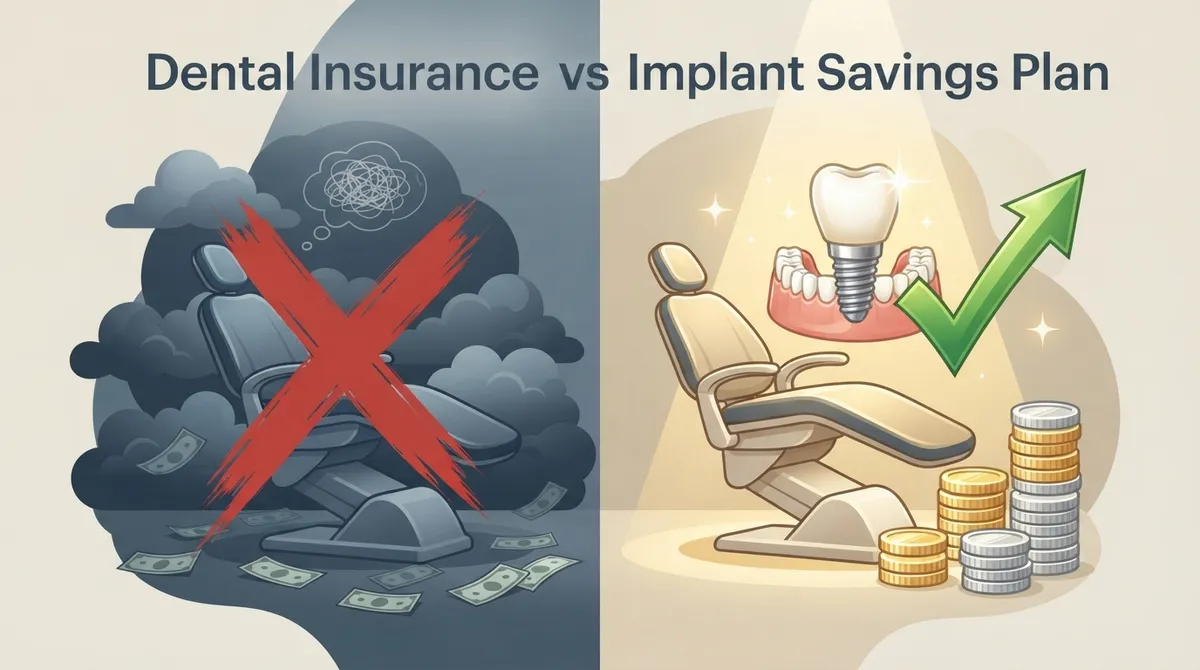
- In-house dental savings plans ($360/year) offer better value than traditional insurance for implants, providing 25% discounts on most procedures with no waiting periods, no annual maximums, and predictable costs versus insurance's confusing exclusions.
- Medical insurance may cover dental implants only if tooth loss resulted from trauma, oral cancer treatment, or a documented medical condition; standard Medicare and Medicaid generally don't cover implants at all.
- Before committing to implant treatment, schedule a free consultation, verify your insurance benefits, compare it against a savings plan option, explore CareCredit or Cherry Financing payment plans, and ask about current promotions to avoid surprise costs.
If you're missing a tooth, you've probably searched "dental implant insurance coverage" more than once, hoping for good news. Here's the honest truth: most dental insurance plans were never built with implants in mind. That can feel frustrating, especially when you just want your smile back without draining your savings. But don't worry, we're here to break it all down in simple terms so you can make a smart choice for your wallet and your smile.
At Charming Smiles of Ocoee, we help patients understand their options every single day. Dr. Aliuska Lopez and her team believe you deserve clear answers, not confusing insurance jargon. So let's compare traditional dental insurance against in-house savings plans and other financing tools, so you can pick the path that actually gets you to a healthier, more confident smile.

Why Dental Implant Insurance Coverage Is So Confusing
Most standard dental insurance plans were designed decades ago, long before implants became a common tooth-replacement option. Because of this, many insurers still label implants as "cosmetic" or "elective," even though replacing a missing tooth is often necessary for your health. This classification means the implant post itself, the titanium piece placed in your jawbone, is frequently excluded from coverage entirely.
Here's what tends to happen with a typical plan:
- The crown on top of the implant might be partially covered
- The abutment (the connector piece) may get some coverage
- Extractions and bone grafting are sometimes included
- Diagnostic X-rays and CT scans are usually covered
- The actual implant post is often left out completely
This patchwork approach leaves many patients confused about what they'll actually pay out of pocket. That's exactly why we always recommend a dental implants consultation first, so you know your real costs before committing to anything.
Traditional Dental Insurance: What You Need to Know
When dental implant insurance coverage does exist, it usually isn't as generous as you'd hope. Here's what the numbers typically look like.
Coverage Percentages and Limits
| Coverage Factor | Typical Range |
|---|---|
| Coverage percentage (when offered) | 40% to 50% of implant cost |
| Annual maximum benefit | $1,000 to $2,500 |
| Average cost per implant | $2,800 to $5,600 |
| Average out-of-pocket with insurance | Around $500 (varies widely) |
| Waiting period before coverage begins | Often 12 months |
See the problem? Even a generous plan covering 50% still leaves you paying $1,400 to $2,800 for just one implant. And if your annual maximum caps out at $1,500, that ceiling gets hit fast once you add exams, cleanings, and other care into the mix.
Waiting Periods Can Slow You Down
Many insurance plans also make you wait before implant benefits kick in. It's common to see:
- Year one: only 20% coverage, if any
- Year two: coverage may increase to 30%
- Year three and beyond: coverage might reach 50%
If you need a tooth replaced now, waiting three years for better coverage just isn't practical. This is one reason so many patients start exploring alternatives right away.
In-House Dental Savings Plans: A Simpler Alternative
This is where things get exciting. Instead of navigating confusing insurance rules, many patients are turning to dental savings plans for straightforward, predictable pricing.
Here's how our Care for Adults and Seniors plan works, at just $360 per year:
- Four bitewing X-rays annually
- One panoramic X-ray every three years
- Four periapical X-rays per year
- Two prophy cleanings per year
- Two fluoride treatments per year
- Two adult exams per year
- 25% off most other dental procedures, including implant-related work
That's a total value of $826 for just $360, which means you save more than 50%. And unlike insurance, there's no waiting period, no annual maximum that runs out, and no confusing exclusions buried in fine print.
Dental Insurance vs. Savings Plan: Side-by-Side Comparison
| Feature | Traditional Insurance | Dental Savings Plan |
|---|---|---|
| Waiting period | Often 12+ months | None |
| Annual maximum | $1,000 to $2,500 | No cap |
| Implant post coverage | Frequently excluded | Discount applies to most services |
| Monthly premiums | Yes, ongoing | One flat annual fee |
| Predictability | Low, varies by claim | High, discounts are fixed |
For many families in Ocoee, this comparison makes the decision pretty clear. A savings plan won't replace insurance for every situation, but for implant care specifically, it often delivers better value.
What About Medical Insurance and Medicare?
Some patients wonder if medical insurance can step in in where dental insurance falls short. The answer is sometimes yes, but only under specific conditions.
Medical insurance may help cover dental implants if your tooth loss resulted from:
- A car accident or other physical trauma
- Oral cancer treatment requiring tooth removal
- A documented medical condition affecting your jaw or teeth
In these cases, your dentist typically needs to submit documentation proving medical necessity. Unfortunately, Medicare and Medicaid generally don't cover dental implants at all, though some Medicare Advantage plans offer limited dental add-ons. If you're an affluent senior weighing your options, it's worth asking our team to help you explore what coverage might apply to your specific case.
Financing Options That Fill the Gap
Whether you have insurance, a savings plan, or neither, financing can help spread out the cost of your implant treatment. At Charming Smiles of Ocoee, we offer several insurance & financing options designed to make treatment accessible.
Here are the steps most patients follow when financing implant treatment:
- Schedule a free implant consultation to get an accurate cost estimate
- Review your insurance benefits, if you have a plan, to see what applies
- Ask about our dental savings plan for ongoing discounts
- Explore payment plans through CareCredit, Alphaeon Credit, or Cherry Financing
- Combine benefits where possible to reduce your total out-of-pocket cost
We also run current specials, including a free dental implant consultation and $200 off implant treatment, so be sure to ask what's available when you call.
Which Insurance Plans Do We Accept?
Charming Smiles of Ocoee works with many major insurance providers to help you maximize whatever benefits you do have. We accept MetLife, United Healthcare, Aetna, Guardian, Renaissance, Cigna, Principal, Delta Dental, Ameritas, GEHA, Humana, United Concordia, and Sun Life.
Don't see your plan listed? No problem. Just give us a call and we'll verify your benefits for you. Understanding your alternatives like dentures or crowns & bridges can also help you compare costs across different tooth-replacement options.
Steps to Take Before Committing to Implant Treatment
Feeling overwhelmed by all this insurance talk is totally normal. Here's a simple checklist to guide you:
- Book a free implant consultation to understand your specific case
- Ask our front desk team to check your insurance benefits
- Compare your insurance coverage against our in-house savings plan
- Ask about current promotions, like our $200 off implant special
- Review financing options if you need to spread out payments
- Confirm your treatment timeline so you know what to expect
Taking these steps before your procedure means no surprises later. Our team walks every patient through this process with patience and warmth, because we know dental costs can feel stressful.
Why Ocoee Patients Trust Charming Smiles for Implant Care
Dr. Lopez and her team have built a reputation across Ocoee for gentle, honest care. We know some patients feel nervous about dental visits, which is why our office includes soothing music, cozy blankets, and a genuinely relaxed atmosphere. You can visit us on Google — Charming Smiles of Ocoee to read what our neighbors are saying about their experience.
We're also active on social media, where we share patient stories and smile transformations. Check out the Charming Smiles Facebook page or follow our Charming Smiles Instagram page for updates on specials and patient results. For general research on dental coverage, resources like the American Dental Association's Health Policy Institute and the Centers for Medicare & Medicaid Services offer helpful background on how coverage rules work nationally.
Making the Right Choice for Your Smile
So which wins, traditional dental implant insurance coverage or an in-house savings plan? Honestly, it depends on your situation. If you already have solid dental insurance, we'll help you use it wisely alongside our discount plan. If your coverage falls short, our savings plan and financing options often provide better value overall.
The most important thing is not letting confusing insurance rules stop you from getting the smile you deserve. Missing teeth can affect your bite, your confidence, and even your overall health over time.
Ready to find out exactly what your implant treatment will cost? Reach out today or call us at (407) 378-3704 to schedule your free consultation. You can also learn more about our full range of general and cosmetic dental services designed to fit every budget and every smile goal.
FAQs
Q: Do dental insurance plans cover the implant post itself?
A: Usually not, unfortunately! Most standard dental plans classify the implant post as cosmetic or elective, so it's often excluded entirely. That's why we always recommend checking your specific plan details or exploring our dental savings plan as a backup option.
Q: What percentage of dental implant costs does insurance typically cover?
A: When coverage is available, most plans cover about 40% to 50% of the cost after your deductible. But since annual maximums usually cap out around $1,000 to $2,500, you'll likely still pay a good chunk out of pocket.
Q: Can medical insurance help pay for dental implants?
A: It can, but only in specific situations like accidents, trauma, or oral cancer treatment where tooth loss is medically necessary. Your dentist will need to document the medical reason, so give our team a call and we can help guide you through it.
Q: Do Medicare or Medicaid cover dental implants?
A: Generally, no, standard Medicare and Medicaid don't cover dental implants. Some Medicare Advantage plans offer limited dental add-ons, so it's worth double checking your specific plan if you're on Medicare.
Q: Is a dental savings plan better than insurance for implants?
A: For many patients, yes! Our in-house savings plan has no waiting periods, no annual maximums, and offers 25% off most procedures right away. It's a simple, predictable way to save without the confusing insurance rules.
Our Service Area
iframe src="https://maps.google.com/maps?q=Ocoee%2C%20FL&z=11&output=embed" width="100%" height="450" style="border:0;" loading="lazy" referrerpolicy="no-referrer-when-downgrade" title="Our Service Area">/iframe>